Read Before You Sign: Seven Handbook Provisions That Invite Litigation
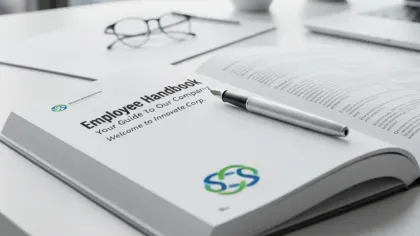
Photo: employee handbook open on desk with pen and glasses, via transform.octanecdn.com
Every employee handbook begins as a shield. Somewhere along the way, though, many of them quietly turn into a sword — one that a plaintiff's attorney can pick up and wield against the very employer who wrote it.
This is not a hypothetical concern. Handbooks are routinely admitted as evidence in employment litigation, and courts in several states have treated certain provisions as creating contractual obligations or as evidence of unlawful intent. Below are seven provisions we see most often in the handbooks that cross our desks — paired with the fix.
1. Overly Broad At-Will Language
Many handbooks declare employment is at-will and then, a few pages later, list progressive discipline steps, probationary periods, or 'just cause' termination standards. Plaintiffs seize on this inconsistency to argue the at-will disclaimer was illusory.
The fix: Make the at-will statement prominent, mutual, and unambiguous — and audit every other section to ensure nothing implies guaranteed process or tenure.
2. Restrictive Confidentiality Clauses
Blanket prohibitions on discussing 'the Company' or 'working conditions' can run afoul of the National Labor Relations Act, which protects employees' right to discuss wages and working conditions — regardless of union status. The NLRB has repeatedly found such clauses unlawful.
The fix: Narrow the definition to legitimate trade secrets, proprietary information, and personal data, and state expressly that the policy does not restrict legally protected activity.
3. Outdated Social Media Rules
Handbooks that prohibit 'disparaging' posts about the employer or require employees to report personal social media accounts invite the same NLRA problems — and can raise privacy concerns in states with lawful off-duty activity statutes.
The fix: Regulate only what the law allows: confidential information, harassment, and brand impersonation. Delete the rest.
4. Vague or Punitive Attendance Policies
'No-fault' attendance programs that count FMLA-protected absences or pregnancy-related leave as occurrences generate discrimination and retaliation claims with remarkable regularity.
The fix: Explicitly exclude protected leave from point accrual and train managers accordingly.
5. Mandatory Arbitration Language With Fatal Flaws
Arbitration clauses can be enforceable — but handbook versions often fail because the handbook also states it is 'not a contract.' You cannot disclaim contractual status everywhere else and then rely on contract status in the arbitration provision.
The fix: Put dispute-resolution terms in a separate, signed agreement with clear offer, acceptance, and consideration language.
6. Rigid Search and Inspection Policies
Clauses asserting the right to search employees' desks, bags, vehicles, or personal devices without limitation collide with state privacy laws and can support intrusion-upon-seclusion claims.
The fix: Reserve searches for legitimate business reasons, with notice, and avoid claiming rights over personal devices and accounts.
7. Boilerplate That Outlived the Law
Handbooks still reference defunct policies, outdated overtime exemptions, or state-specific rules that no longer apply — or, worse, omit state-specific requirements that now do. Multi-state employers are especially exposed.
The fix: Conduct an annual, jurisdiction-by-jurisdiction review, and include a prominent disclaimer that the handbook is not an employment contract.
Compliance Confidence Starts on Paper
A handbook should be a living document, reviewed with the same rigor as any financial statement. If yours has not been touched in two years, assume it contains at least one of the provisions above. BHI ERC's workplace experts help organizations audit, revise, and modernize their handbooks so the document works as protection — not as a plaintiff's exhibit. Reach out to our team for a confidential review.